CE Tips

Strength of Materials 4th Edition


The popularity of the third edition and reprints of the textbook of Strength of Materials amongst the students and the teachers of the various Universities of the country, has prompted the bringing out of the fourth edition of the book so soon. The fourth edition has been thoroughly revised and brought up-to-date. A large number of problems from different B.E. degree examinations upto 2005 of Indian Universities and other examining bodies, such as Institution of Engineers U.P.S.C. (Engineering Services) and Gate have been selected and have been solved at proper places in this edition in S.I Units.
Three advanced topics of Strength of Materials such as stresses due to rotation in thin and thick cylinders, bending of curved bars and theories of failure of the material have been added. These chapters have been written in such a simple and easy-to-follow language that even an average student can understand easily by self-study. In the chapter of 'Columns and Struts', the advanced articles such as columns with eccentric load, with initial curvature and beam columns have been included. The notations· in this edit~on have been used upto-date by the use of sigma and tau for stresses.

The objective type multiple-choice questions are often asked in the various competitive examinations. Hence a large number of objective type questions with answers have been added in the end of the book. Also a large number of objective type questions which have been asked in most of competitive examinations such as Engineering Services Examination and Gate with answers and explanation have been incprporated in this edition. With these editions, it is hoped that the book will be quite useful for the students of different branches.


Read More
CE Tips

TOS1: Determine the force in each member of the truss

Determine the force in each member of the truss and state if the members are in tension or compression.


Read More
CE Tips

Statics: Determine the fourth force


The 100-lb resultant of four forces together with the three of those four forces is shown. 
Determine the fourth force (P).


Rx = 100 cos45º = 70.71 lb
Ry = 100 sin45º = 70.71 lb


→+ΣFx = 70.71     
-70cos60º - 120cos60º + 50cos50º + Px = 70.71
Px = 133.571 lb


↑+ΣFy = 70.71
-70sin60º - 120sin60º -50sin50º + Py = 70.71
Py = 152.313 lb

P2 = Px2 + Py2
P2 = (133.571)2 + (152.313)2 
P = 202.58 lb


for theta (θ)
tan(θ) = 152.313 / 133.571
θ = 48.75º


Read More
CE Tips

Concrete Pavement Design Guidance Notes - Geoffrey Griffiths, Nick Thom


This comprehensive design guide summarizes current developments in the design of concrete pavements. Following an overview of the theory involved, the authors detail optimum design techniques and best practice, with a focus on highway and infrastructure projects.

Worked examples and calculations are provided to describe standard design methods, illustrated with numerous case studies. The author provides guidance on how to use each method on particular projects, with reference to UK, European and US standards and codes of practice.

Concrete Pavement Design Guidance Notes is an essential handbook for civil engineers, consultants and contractors involved in the design and construction of concrete pavements, and will also be of interest to students of pavement design.


Read More
CE Tips

Structural Foundation Designers' Manual - W. G. Curtin, Gerry Shaw


This manual for civil and structural engineers aims to simplify as much as possible a complex subject which is often treated too theoretically, by explaining in a practical way how to provide uncomplicated, buildable and economical foundations.

It explains simply, clearly and with numerous worked examples how economic foundation design is achieved. It deals with both straightforward and difficult sites, following the process through site investigation, foundation selection and, finally, design.

The book:

  • includes chapters on many aspects of foundation engineering that most other books avoid including
    • filled and contaminated sites 
    • mining and other man-made conditions
  • features a step-by-step procedure for the design of lightweight and flexible rafts, to fill the gap in guidance in this much neglected, yet extremely economical foundation solution 
  • concentrates on foundations for building structures rather than the larger civil engineering foundations 
  • includes many innovative and economic solutions developed and used by the authors’ practice but not often covered in other publications 
  • provides an extensive series of appendices as a valuable reference source. 


Read More
CE Tips

Statics: A truss structure is used to hold power lines as illustrated


A truss structure is used to hold power lines as illustrated. The power lines provide forces skewed to the tower. Calculate the reaction forces at the base of the tower.


Solution
↻+ (clockwise-positive)
→+ (right-positive)
↑+ (upward-positive)


→+ΣFx = 0    assume Ax is postive
Ax - 300sin30º + 400sin25º = 0
Ax = -19.05N
Ax = 19.05N (←)


↻+ΣMA = 0
-By(4) + 400cos25º (4+2) + 400sin25º (10) -300cos30º (2) -300sin30º (10)=0
By = 461.50N


↻+ΣMB = 0    assume Ay is positive (↑+)

Ay(4) - 300cos30º (2+4) - 300sin30º (10) + 400cos25º (2) + 400sin25º (10) = 0
Ay = 160.83N 


Read More
CE Tips

Statics: A mother would like to balance her son on the teetor totter


A mother would like to balance her son on the teetor totter. Calculate the distance "d" so that the system is in equilibrium. Also calculate the reaction at point O.

Solution

↻+ (clockwise positive)

↻+ΣMo = 0
-120lb (d) + 43lb (4ft) = 0
d = 1.433 ft

→+ΣFx = 0
Ox = 0

↑+ΣFy = 0
-120lb + Oy - 43lb = 0
Oy = 163 lb


Read More
CE Tips

Statics: Calculate the reactions


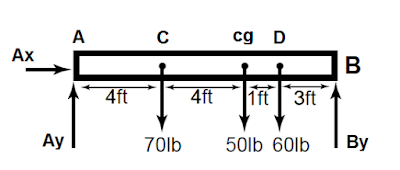
Two children are swinging from 12-ft long jungle gym that weighs 50-lbs. Child C weighs 70-lbs and the child at D weighs 60-lbs. Calculate the reactions for the pin at A and the roller at B.


Solution


↻+ (clockwise positive)

↻+ΣMA = 0
70lb (4ft) + 50lb (8ft) + 60lb (9ft) - By(12ft) = 0
By = 101.667 lb
B = 101.667 lb 

↻+ΣMB = 0
Ax(0) + Ay(12) - 70(8) - 50(4) - 60(3) = 0

Ay = 78.333 lb
A = 78.333 lb


Checking;
 ↑+ΣFy = 0
78.333 - 70 - 50 - 60 + 101.667 = 0
0 = 0


Read More