Showing posts with label statics. Show all posts
CE Tips

Statics: CE Nov. 2010 - Two tension wires are supported by a concrete block


Two tension wires are supported by a concrete block attached to an anchor ring as shown in the figure.


1. Which of the following most nearly gives the resultant force in the anchor ring?
       a.  7.28 KN                                   c.  9.07 KN
       b.  10.42 KN                                 d.  5.16 KN


2. Which of the following most nearly gives the angle that the resultant force makes with the horizontal?

       a.  43.67°                                      c.  39.55°
       b.  53.17°                                      d.  48.72


For #1

→+ΣFx     (horizontal)
Rx = -7cos15° + 3.5cos30° = -3.7304 =  -3.73 KN


↑+ΣFy     (vertical)
Ry = 7sin15° + 3.5sin30° = 3.5617 =  3.562 KN


Use the Pythagorean Theorem
R² = Rx² + Ry²
R² = (-3.73)² + (3.562)²
R = 5.16 KN


For #2

tan θ = |Ry/Rx|
tan θ = |3.562/-3.73|
θ = 43.67°


Text Box: WText Box: 3.50 KNText Box: 7 KNText Box: 15°          30°
Text Box: WText Box: 3.50 KNText Box: 7 KNText Box: 15°          30° θ = |tan-1(3.562/-3.73)|
θ = 43.67°

Read More
CE Tips

Engineering Mechanics: STATICS (Solution Manual)


Over the past 50 years, Meriam & Kraige's Engineering Mechanics: Statics has established a highly respected tradition of excellence--a tradition that emphasizes accuracy, rigor, clarity, and applications. Now in a Sixth Edition, this classic text builds on these strengths, adding a comprehensive course management system, Wiley Plus, to the text, including an e-text, homework management, animations of concepts, and additional teaching and learning resources. New sample problems, new homework problems, and updates to content make the book more accessible. 

The Sixth Edition continues to provide a wide variety of high quality problems that are known for their accuracy, realism, applications, and variety motivating students to learn and develop their problem solving skills. To build necessary visualization and problem-solving skills, the Sixth Edition continues to offer comprehensive coverage of drawing free body diagrams-- the most important skill needed to solve mechanics problems.


Read More
CE Tips

Engineering Mechanics 3Ed - K. L. Kumar


Engineering is an activity concerned with the creation of new systems for the benefit of mankind. The process of creativity proceeds by way of research, design and development; new systems emerge from innovation and systems may be constituted by mechanical, electromechanical, hydraulic. thermal or other elements. Creation of new systems is thus basic to all engineering. The Living Webster Encyclopedic Dictionary aptly defines engineering as the art of excelling a partial application of scientific knowledge.

lt is important to understand the difference between engineering and science. Science is concerned with a systematic understanding and gathering of the facts, laws and principles governing natural phenomena. Engineering, on the other hand, is an art of utilisation of the established facts, laws and principles to create certain desired phenomena. The activities of science and engineering arc thus mutually opposite. Both may proceed through similar ways and means of analysis and synthesis but are oppositely directed. The training of scientists and engineers should be correspondingly designed for their respective objectives.


Read More
CE Tips

Statics: Determine the fourth force


The 100-lb resultant of four forces together with the three of those four forces is shown. 
Determine the fourth force (P).


Rx = 100 cos45º = 70.71 lb
Ry = 100 sin45º = 70.71 lb


→+ΣFx = 70.71     
-70cos60º - 120cos60º + 50cos50º + Px = 70.71
Px = 133.571 lb


↑+ΣFy = 70.71
-70sin60º - 120sin60º -50sin50º + Py = 70.71
Py = 152.313 lb

P2 = Px2 + Py2
P2 = (133.571)2 + (152.313)2 
P = 202.58 lb


for theta (θ)
tan(θ) = 152.313 / 133.571
θ = 48.75º


Read More
CE Tips

Statics: A truss structure is used to hold power lines as illustrated


A truss structure is used to hold power lines as illustrated. The power lines provide forces skewed to the tower. Calculate the reaction forces at the base of the tower.


Solution
↻+ (clockwise-positive)
→+ (right-positive)
↑+ (upward-positive)


→+ΣFx = 0    assume Ax is postive
Ax - 300sin30º + 400sin25º = 0
Ax = -19.05N
Ax = 19.05N (←)


↻+ΣMA = 0
-By(4) + 400cos25º (4+2) + 400sin25º (10) -300cos30º (2) -300sin30º (10)=0
By = 461.50N


↻+ΣMB = 0    assume Ay is positive (↑+)

Ay(4) - 300cos30º (2+4) - 300sin30º (10) + 400cos25º (2) + 400sin25º (10) = 0
Ay = 160.83N 


Read More
CE Tips

Statics: A mother would like to balance her son on the teetor totter


A mother would like to balance her son on the teetor totter. Calculate the distance "d" so that the system is in equilibrium. Also calculate the reaction at point O.

Solution

↻+ (clockwise positive)

↻+ΣMo = 0
-120lb (d) + 43lb (4ft) = 0
d = 1.433 ft

→+ΣFx = 0
Ox = 0

↑+ΣFy = 0
-120lb + Oy - 43lb = 0
Oy = 163 lb


Read More
CE Tips

Statics: Calculate the reactions


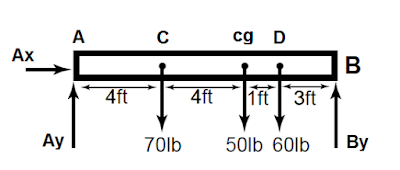
Two children are swinging from 12-ft long jungle gym that weighs 50-lbs. Child C weighs 70-lbs and the child at D weighs 60-lbs. Calculate the reactions for the pin at A and the roller at B.


Solution


↻+ (clockwise positive)

↻+ΣMA = 0
70lb (4ft) + 50lb (8ft) + 60lb (9ft) - By(12ft) = 0
By = 101.667 lb
B = 101.667 lb 

↻+ΣMB = 0
Ax(0) + Ay(12) - 70(8) - 50(4) - 60(3) = 0

Ay = 78.333 lb
A = 78.333 lb


Checking;
 ↑+ΣFy = 0
78.333 - 70 - 50 - 60 + 101.667 = 0
0 = 0


Read More
CE Tips

Engineering Mechanics STATICS 12 Ed - R.C. Hibbeler


Mechanics is a branch of the physical sciences concerned with the state of rest or motion of bodies that are subjected to the action of forces. The study of mechanics involves many more subject areas. However, initial study is usually split into two areas; statics and dynamics.

Statics is concerned with bodies that are either at rest or move with a constant speed in a fixed direction. Dynamics deals with the accelerated motion of bodies. Statics can therefore be considered as a special case of dynamics where the acceleration is zero. In engineering, since many objects are designed with the intention that they are at rest or their motion remains constant, statics deserves special treatment.


Read More
CE Tips

Determine the reactions on the beam


Determine the reactions on the beam shown


→+ΣFx = 0
Ax - 270cos60° = 0
Ax = 135 KN


↻+ΣMA = 0
270sin60° (3) - 270cos60° (0.3) + 6.8 - By(4.2) = 0
By = 159 KN


↻+ΣMB = 0
Ay(4.2) - 270sin60° (1.2) - 270cos60° (0.3) + 6.8 = 0
Ay = 74.8 KN

or

 ↑+ΣFy = 0
Ay - 270sin60° + 159 = 0
Ay = 74.8 KN


Ans.
Ax = 135 KN
By = 159 KN
Ay = 74.8 KN


Read More
CE Tips

Statics: Determine the reactions at the supports


A small pedestrian bridge is supported by a rocker at an end (B) and a pin at the other (A). A 200-lb person is standing 4-ft out from point A. The bridge has a weight of 500-lb. Assuming the center of gravity is in the middle of the bridge, calculate the reaction at points A and B.


Solution


↻+ (clockwise positive)

↻+ΣMA= 0
200lb (4ft) + 500lb (10) - By (20ft) = 0
By = 290 lb
B = 290 lb


↻+ΣMB= 0
Ax (0) + Ay (20ft) - 200lb (16ft) - 500lb (10ft) = 0
Ay = 410 lb

A = 410 lb


Check;
↑+ΣFy = 0
410 - 200 - 500 + 290 = 0
0 = 0


Read More
CE Tips

Statics: Force system (CE May 1998)

For the force system show in the figure:


1. Which of the following most nearly gives the magnitude, in Newtons, of the horizontal component of the force system (positive to the right):
A. -50                         C. 25
B. -25                         D. 50


2. Which of the following most nearly gives the magnitude, in Newtons, of the force needed to put the system in equilibrium:
A. 35                         C. 25
B. 50                         D. 44


3. Which of the following most nearly gives the angle, in degrees, that the force needed to put the system in equilibrium makes with the horizontal axis (positive counterclockwise):
A. -45                         C. 45
B. 135                        D. -135


Read More